.png)

That era is ending. We are transitioning into the Companion Economy, a shift where the primary interface for the customer is no longer a website or an app, but an AI Companion.
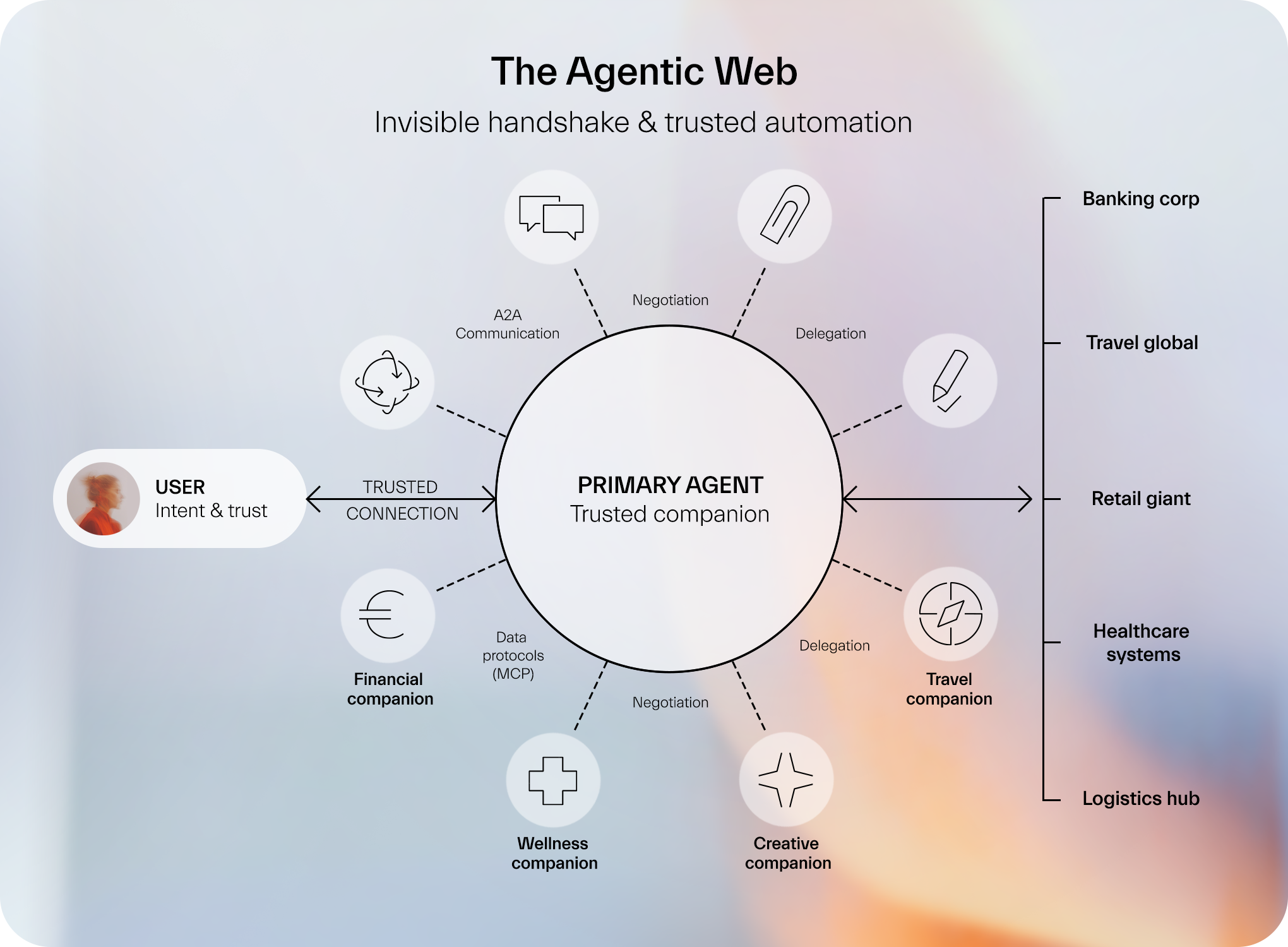
But this is not just a change in User Experience (UX); it is a fundamental re-architecture of the web itself. The "Companion" is not merely a chatbot—it is an autonomous LLM Agent. These agents are moving us from a world of "users browsing pages" to a world of "agents negotiating with agents."
In this new reality, your brand is at risk of becoming "just an API" hidden behind an AI interface that owns the customer relationship. To understand how to survive, we must look beyond the boardroom strategy and into the technical protocols that are building this new world.
The rise of the agentic web
To understand the Companion Economy, we must first define the technical unit of value: the LLM Agent.
A standard Large Language Model (LLM) is passive; it waits for a prompt and predicts text. An Agent, however, is an LLM equipped with three additional capabilities:
- Agency: The ability to plan a sequence of actions to achieve a goal.
- Tool Use: The ability to execute code, browse the web, or call APIs.
- Memory: The ability to retain context over time (State).
When a user interacts with a Companion, they are not searching; they are delegating. They ask the AI to "recommend, compare, decide, and act".
This delegation breaks the traditional funnel. The user does not visit ten different travel sites to book a holiday. They state their intent—"Book a weekend in Helsinki for under $500"—and their Personal Agent executes the task. The Agent acts as a proxy, handling the complexity of the digital supply chain in milliseconds.
The connectivity layer: MCP and the "API-fication" of everything
In the browser era, humans navigated the web using HTML (visual structure). In the Companion era, Agents navigate the world using data protocols.
The major bottleneck for Agents has been connecting to proprietary data. How does a generic AI know what is in your inventory, your calendar, or your bank account?
Enter the Model Context Protocol (MCP) and similar emerging standards.
MCP acts as the "USB-C" for AI applications. It provides a standardized way for an LLM Agent to connect to external data catalogs and systems without needing custom integrations for every single service. It allows a brand to expose its data (products, prices, availability) in a format that an Agent can ingest, understand, and act upon securely.
This creates a profound shift in how businesses must structure their digital presence. You are no longer designing a visual "User Interface" (UI) for a human; you are designing a "Data Interface" for an Agent.
If your business exposes its services via robust MCP servers or well-documented APIs, you become "visible" to the Agentic Web. If you rely solely on a visual website with messy HTML, you become invisible. The Agent will simply bypass you in favor of a competitor whose data is machine-readable.
The hierarchy of trust restructures the value chain: who owns the user?
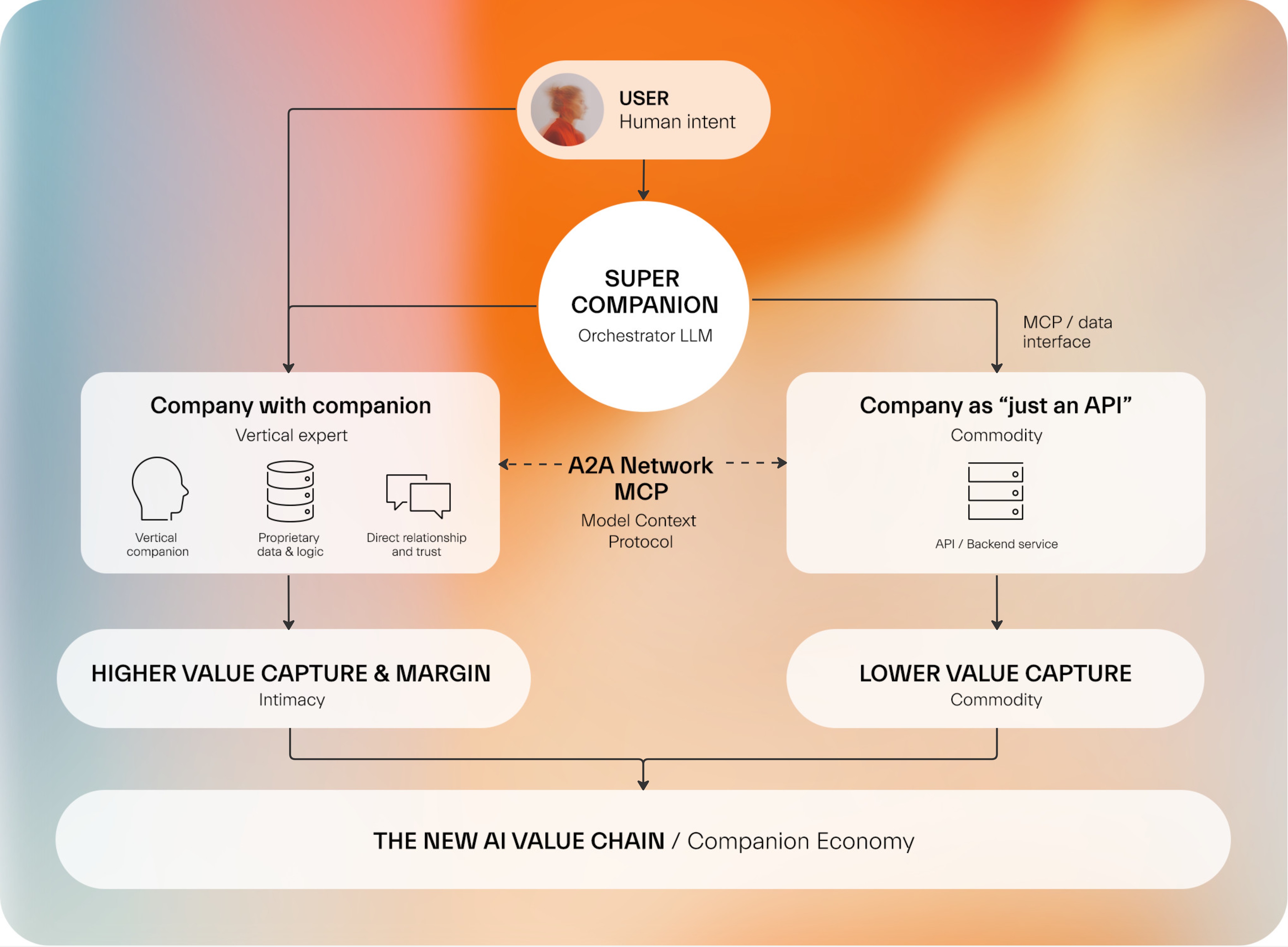
If the interface disappears into a background conversation between agents, the economic question shifts. The digital economy is no longer about who controls the traffic, but who controls the trust. This hierarchy of trust restructures the entire value chain, determining who captures the margin and who becomes a commodity.
The value chain is reconfiguring into three distinct layers based on relationship ownership:
-
1. The Super Companion (The Orchestrator)
-
At the top of the value chain sit the Super Companions—the "browsers" of the AI age (e.g., ChatGPT, Gemini, Claude, etc). They own the primary interface and the user's daily attention.
- Value Chain Position: They act as the new gatekeepers. Because they own the relationship, they have the power to tax the ecosystem.
- Economic Impact: Just as app stores take a 30% cut today, Super Companions are positioned to demand significant commissions on every transaction they mediate. If your brand reaches the customer through them, you are paying a toll for access.
-
2. The Vertical Companion (The Trusted Expert)
Below the generalists are the Vertical Companions. These are specialized agents that dominate specific lifestyles or high-stakes domains—such as travel, health, or finance.
- Value Chain Position: They compete on "Intimacy" rather than reach. A user might ask ChatGPT for a poem, but trust a dedicated "Financial Companion" with their retirement planning.
- Economic Impact: These players protect their margins by holding a deeper, specific trust. They may plug into Super Companions for distribution, but they retain the core data and relationship logic.
-
3. The Backend Provider (The API)
At the base of the chain are the brands that fail to build a Companion strategy. They become "Just an API".
- Value Chain Position: They provide the product or service (the flight, the shoe, the hotel room), but they are invisible to the end user.
- Economic Impact: While they may still get the sale, they lose the customer relationship. They become interchangeable commodities selected by an algorithm based on price and availability, stripped of brand differentiation.
-
Agent-to-agent (A2A): The new supply chain
This restructured value chain will operate on an Agent-to-Agent (A2A) network.
Consider a complex transaction, such as planning a corporate event. No single "Super Companion" can be an expert in everything. Instead, we will see a chain of automated negotiation:
- The User's Primary Agent (The Trust Holder) receives the intent.
- The Orchestration Layer broadcasts the need to the network.
- Specialist Agents (representing hotels, caterers, and transport) respond with offers via A2A protocols.
These agents will haggle over price, verify delivery windows, and finalize contracts without a human ever seeing a "Checkout" button. This redefines the concept of a "customer." For many businesses, your direct customer will soon be a piece of software acting on behalf of a human.
Strategic imperatives: How to compete
The shift to an AI-mediated economy requires a total "operating model" transformation. It is not enough to just "add AI" to your current app. You must decide where you sit in this new hierarchy.
-
1. Identify your role
-
Are you an Orchestrator, a Companion Builder, or a Partner?.
- Orchestrator: Telcos and Banks with massive data sets can attempt to build the ecosystem where others connect.
- Companion Builder: High-trust brands (Health, Insurance) should build their own proprietary Companions to own the interface and the relationship.
- Partner: Mid-sized brands must ensure they are the most frictionless nodes in the network, plugging into Super Companions like ChatGPT or Atlas to ensure reach.
2. Shift from "SEO" to "AIO" (Artificial Intelligence Optimization)
We spent years optimizing content for Google’s crawlers. Now, we must optimize for Agents. This means structuring data so it is semantically rich and easily ingestible by LLMs. If an agent cannot parse your pricing model via API, it will simply ignore you.
3. Trust is the new loyalty
In an app, loyalty was about "stickiness"—gamification and notifications. In the Companion Economy, loyalty is about intimacy. Users will share their deepest fears and financial data with their AI Companions. They will pay a premium for a Companion that serves their interests, not the advertiser's—users have already indicated a willingness to pay up to $98/month for their trusted Companions.
Conclusion
The Companion Economy is the realization of a digital environment where software works for us, rather than requiring us to work for it.
As we move toward a future defined by Agent-to-Agent communication and MCP-driven data exchange, the brands that cling to the "website-first" mentality will find themselves at the bottom of the value chain—invisible utilities serving the new AI overlords.
The opportunity is massive: the ability to be part of a continuous, intelligent dialogue with your customer. But the threat is equally stark: in an economy of automated companions, if you cannot talk to the machine, you cannot sell to the human.
The interface is dissolving. The relationship is everything.
About the author |
|||
|
|
Tapio Pitkäranta |
||
|
With over 20 years of experience in AI, Tapio Pitkäranta has been at the forefront of autonomous systems since their academic infancy. His career has spanned multiple CTO roles at high-growth startups, where he has specialized in scaling AI across diverse sectors like healthcare, retail, and tax. Today, Tapio remains deeply hands-on, integrating advanced AI agents into daily workflows to bridge the gap between pioneering research and real-world commercial impact. |
|||